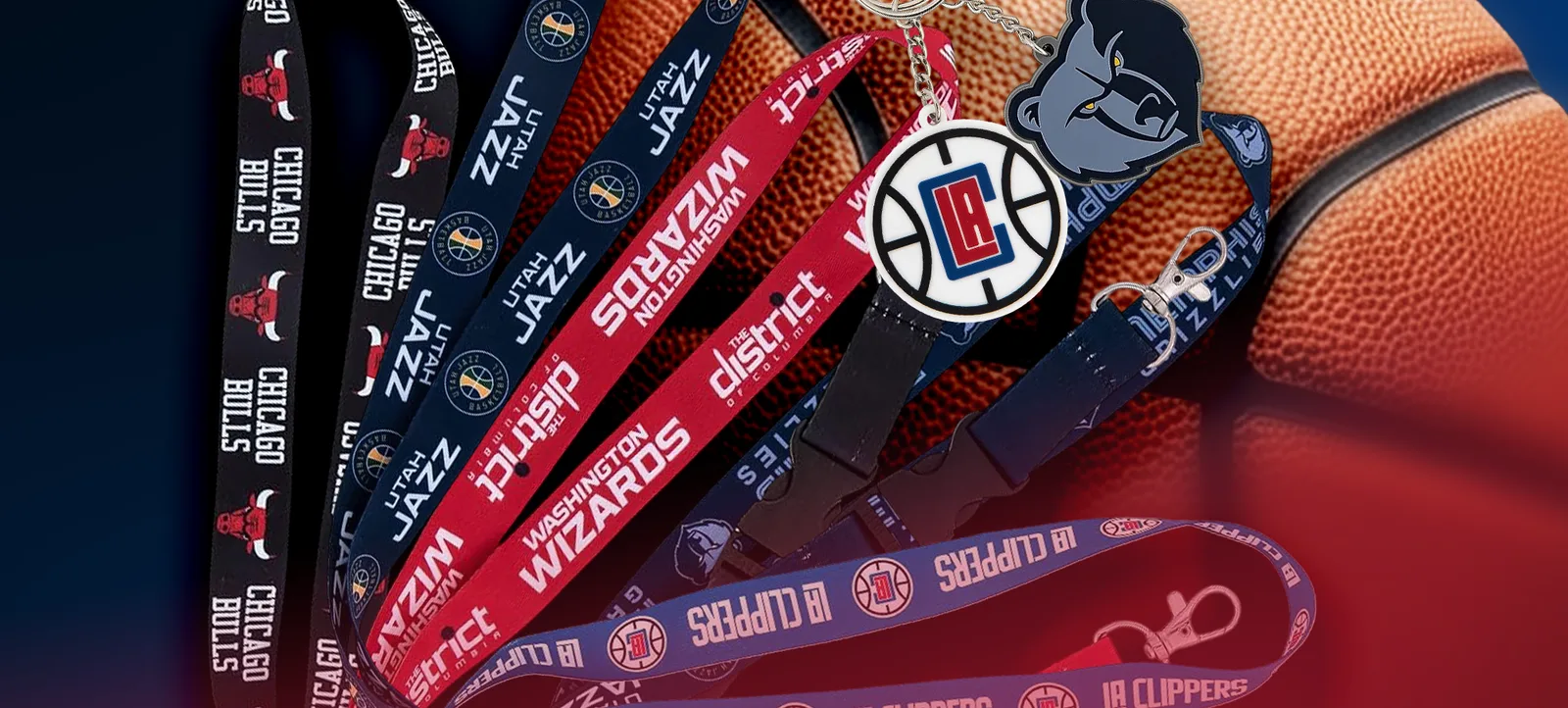
The cheapest thing you own with your team on it
A flag is an event. You buy one, you hang it, you look at it. A pin, a lanyard or a keyring is different: it is with you every day, it goes through pockets and doors and airport trays, and it fails in ways a flag never does.
We make 233 lapel pins and 358 lanyards, and this guide is about the parts of them nobody photographs. The clasp. The ring. The buckle. Those are what decide whether the thing is still on your jacket in a year.
Enamel pins, and how to spot a cheap one
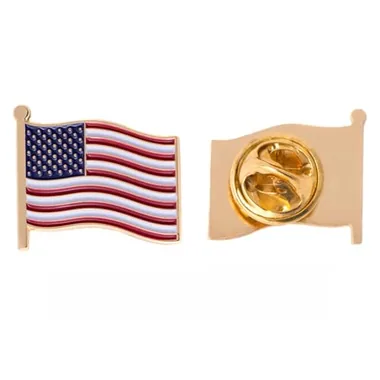
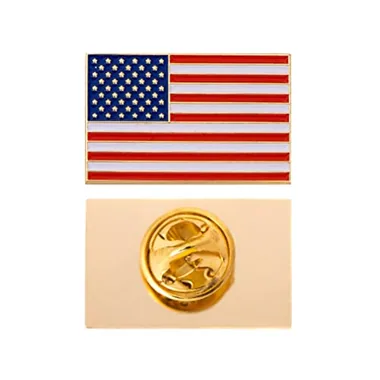
United States of America Lapel Pin
Enamel on metal · $5.90

There are two ways to put a logo on a small piece of metal. The good way is to strike the metal so the design is physically raised and recessed, then fill the recesses with enamel and polish the raised metal lines back to bright. The result has real edges you can feel with a thumbnail, and the colour is a material rather than a picture.
The cheap way is to print the design onto a flat disc and cover it with a clear plastic dome. From two feet away it looks similar. Up close the dome is obviously a lens, the print has dots if you look hard, and the edge of the dome collects grime. It also scuffs, and a scuffed dome cannot be polished because the scratch is in the plastic rather than the metal.
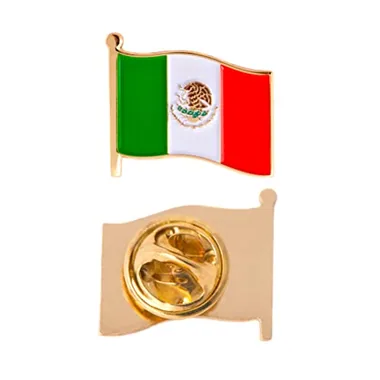
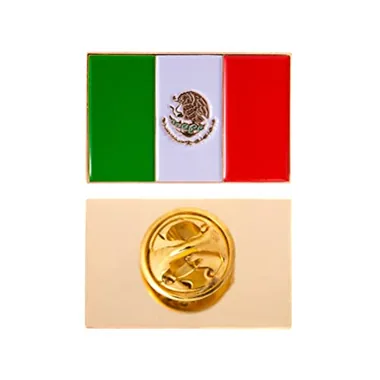
Mexico Lapel Pin
Enamel on metal · $8.99
Ours are struck metal with an enamel finish. The reason is not craft romance, it is that a struck pin looks the same in five years and a printed dome does not.
| Test | Struck enamel | Printed dome |
|---|---|---|
| Run a thumbnail across it | You feel ridges between colours | Perfectly smooth |
| Look at the edge | Metal border, polished bright | Plastic lip over a flat disc |
| Tilt it to the light | Colour stays flat and even | Lens effect, highlight moves |
| After two years | Same, maybe duller metal | Scuffed, edge dirty |
The clasp is what you actually lose
Nobody loses a pin because the pin broke. They lose it because the clasp came off in a coat pocket. Our pins use a butterfly clasp, which is the two winged clutch you squeeze to release. It is the standard for a reason: cheap, secure enough, and replaceable for pennies.
It is also the weak point. The wings loosen with repeated use, and a clutch that has been pushed on and pulled off a hundred times grips less than it did. If a pin matters to you, replace the clutch once a year, or switch to a locking clutch that screws or slides rather than gripping by friction.
The other trick costs nothing. Put a small piece of rubber tubing or a rubber clutch behind the butterfly. It doubles the grip and it is invisible from the front.
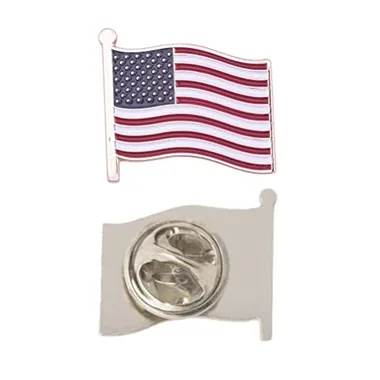
United States of America Lapel Pin
Enamel on metal · $6.95
- Butterfly clutches wear out.The wings lose their spring after repeated use. Replace them before you lose the pin, not after.
- Rubber backing behind the clutch.A few pence of rubber tubing roughly doubles how hard the clutch is to dislodge.
- Locking clutches for the ones that matter.Screw or slide fittings do not rely on friction at all.
- Do not pin through knitwear.The pin opens a hole that grows. Pin through a woven backing, or use a magnetic fitting.
Lanyards, buckles and the one that saves your neck
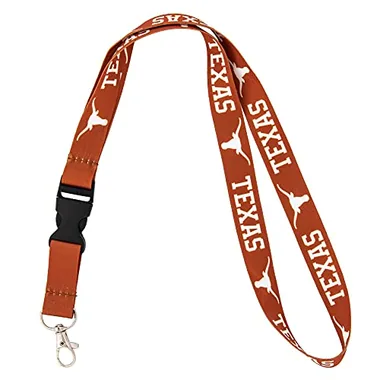
A lanyard is a woven strap, a fitting on the end and usually a buckle in the middle. Ours are printed on woven polyester with a snap buckle and a detachable ring, which sounds like marketing until you have used one without either.
Mexico Lapel Pin
Enamel on metal · $8.99
The snap buckle is what lets you take the lanyard off without pulling it over your head, which matters if you wear glasses or have hair. The detachable ring is what lets you hand your keys to somebody without handing them your badge as well.
The one people do not know to ask for is the breakaway clasp. This is a fitting at the back of the neck designed to come apart under load. In a workshop, a lab, a kitchen or anywhere with machinery, a lanyard that does not break away is a hazard rather than an accessory, because it is a loop around your neck attached to something that can be caught. If the lanyard is going to be worn near moving equipment, insist on a breakaway.
| Fitting | Where it sits | What it does | When you need it |
|---|---|---|---|
| Snap buckle | Middle of the strap | Opens so you can remove it without lifting it over your head | Everyday wear |
| Detachable ring | Just above the clip | Separates keys from badge | Sharing keys, valet parking |
| Breakaway clasp | Back of the neck | Comes apart under load | Anywhere near machinery |
| Swivel hook | The end | Stops the strap twisting | Heavy key bunches |
Keyrings, and the split ring nobody can open
The split ring is the flat coiled ring that holds keys, and it is the single most hated object in this category. Opening one with fingernails is unpleasant and it is how nails break.
The trick is a staple remover. The kind with two opposed jaws grips the coil and lifts it open with no effort at all, and it takes about two seconds. Failing that, a table knife slid into the gap works.
Beyond that, keyrings are simple objects and the only real variable is the material of the fob. Ours are PVC or clear acrylic printed with fade resistant ink. PVC is soft, survives being dropped, and rounds off at the corners over years. Acrylic is hard, keeps a crisp edge, and will crack if it goes under a car tyre. Neither is better. They fail differently.
The small parts rule, and why we bring it up unprompted
United States of America Lapel Pin
Enamel on metal · $6.95
Every so often a customer asks whether a pin is safe with a small child in the house, and the honest answer involves a specific federal rule rather than reassurance. The Consumer Product Safety Commission defines a physical test for whether an object is a choking hazard, and it is refreshingly concrete.
Place the article, without compressing it, into the cylinder. If the article fits entirely within the cylinder, in any orientation, it fails to comply with the test procedure.16 CFR Part 1501 — Method for identifying toys and other articles intended for use by children under 3 years of age which present choking, aspiration, or ingestion hazards, U.S. Consumer Product Safety Commission, via the Electronic Code of Federal Regulations. Read 20 August 2026.
The cylinder in question is a little over an inch across and between one and two and a quarter inches deep, sized to approximate the throat of a young child. A one inch lapel pin fits inside it. So does a butterfly clutch on its own. So does a split ring, and so do the screws packed with a plate frame.
The rule applies to articles intended for children under three, and the regulation is careful about how intent is decided.
In determining which toys and other articles are intended for use by children under 3 years (36 months) of age, for purposes of this regulation, the following factors are relevant: the manufacturer's stated intent (such as on a label) if it is a reasonable one; the advertising, promotion, and marketing of the article; and whether the article is commonly recognized as being intended for children under 3.16 CFR Part 1501 — Method for identifying toys and other articles intended for use by children under 3 years of age which present choking, aspiration, or ingestion hazards, U.S. Consumer Product Safety Commission, via the Electronic Code of Federal Regulations. Read 20 August 2026.
By that measure our pins and keyrings are not children's articles. We do not make them as toys, we do not market them to children, and nobody would recognise a collegiate lapel pin as a toddler's item. That is the legal position and it is accurate.
It is also not the question a parent is asking. The question is whether the object is dangerous if a small child gets hold of it, and the answer to that is yes, in exactly the way a coin or a button battery is dangerous. Store them the same way.
Where a pin goes, and what it does to the fabric
A lapel pin is a spike pushed through cloth, and cloth has opinions about that. On a woven jacket lapel, which is what the format was designed for, the threads part around the pin and close again when it comes out. That is why the format exists and why nobody worries about it.

University of Michigan Wolverines Flag
3 x 5 ft · Polyester · $24.75
On knitwear it is a different story. A knit is a single yarn looped through itself, and a pin does not part it, it stretches one loop. Do that repeatedly in the same place and the loop eventually breaks, which on a knit means a run rather than a hole. If a pin is going on a jumper, put a small piece of felt or a proper pin backing behind the fabric to spread the load.
Backpacks and canvas bags are the friendliest surface of all. The fabric is heavy, the weave is coarse, and a pin sits solidly. This is where pin collections tend to end up, and it is the right place for them.
University of Texas Garden Flag
12 x 18 in · Polyester · $13.99
Caps are popular and slightly awkward. A pin on the front panel of a structured cap has to go through a stiffener as well as the fabric, which is harder to push and much harder to remove. Pin through the side panel instead, where there is only fabric and lining.
| Surface | How it takes a pin | Precaution |
|---|---|---|
| Jacket lapel, woven | Cleanly. Threads part and close | None |
| Canvas bag or backpack | Very well. Heavy, coarse weave | None |
| Cap side panel | Well | Avoid the stiffened front panel |
| Knitwear | Poorly. Stretches a loop | Felt or backing behind the fabric |
| Leather | Permanently. The hole stays | Decide once, then commit |
How a lanyard is printed, and why some fade
Three different processes are sold as printed lanyards and they age completely differently. That is how two apparently identical straps end up looking nothing alike after a year of daily wear.
Screen printing lays ink on top of the woven strap. It is cheap, the colour is bright on day one, and it wears off at the fold points first, so a screen printed lanyard develops pale patches exactly where it bends over your collar.
Dye sublimation puts the dye into the fibre rather than on it. The colour goes all the way through, which means it cannot rub off, and the strap stays legible until the strap itself wears out. It also allows full colour artwork, which matters for a crest.
Texas Longhorns Lanyard
Polyester · $11.99
Woven, the third, means the pattern is made from coloured threads during weaving rather than added afterwards. It is the most durable of all and the least detailed, because the resolution is limited by the thread. Woven straps suit letters and simple marks and cannot reproduce a complex crest.
Ours are printed on woven polyester with the artwork through the fibre. That is how the pieces we sell for campus use come back looking usable after a full academic year of being sat on, shut in doors and washed by accident.
| Method | Colour depth | Detail possible | How it ages |
|---|---|---|---|
| Screen print | Surface only | Simple shapes | Rubs off at fold points |
| Dye sublimation | Through the fibre | Full colour, fine detail | Fades slowly and evenly |
| Woven | Coloured threads | Letters and simple marks | Outlasts the fittings |
Cleaning, storing and the things that ruin them
None of these objects need much care, and all three are commonly ruined by the same mistake, which is a washing machine.
A lanyard survives a cold hand wash with soap and a rinse. It does not survive a hot machine wash, because heat and agitation together distort the plastic buckle and dull the strap. If a lanyard has gone through the wash by accident it is usually fine, but do not make a habit of it.
Metal pins clean with a soft cloth and nothing else. Do not use metal polish on an enamel pin: polish is abrasive and it will haze the enamel while it brightens the metal, and haze does not come back out. If a pin has gone dull, warm soapy water and a soft toothbrush is the whole procedure.

University of Texas Austin Longhorns Flag
3 x 5 ft · Polyester · $24.75
PVC and acrylic keyrings clean with soap and water. Keep solvents away from acrylic in particular, because alcohol and acrylic together produce fine surface cracking that appears days later and cannot be undone.
For storage, a pin board or a strip of felt keeps a collection visible and undamaged. Pins loose in a drawer scratch each other, and enamel against enamel is the one combination that chips.
- Never machine wash a lanyard hot.Heat distorts the buckle and dulls the strap. Cold hand wash only.
- No metal polish on enamel.It brightens the metal and hazes the colour permanently.
- No alcohol on acrylic.It causes fine cracking that shows up days later.
- Store pins on felt or a board.Loose in a drawer they chip each other.
Collecting, trading and the reason pins persist
Florida State University FSU Flag
3 x 5 ft · Polyester · $24.75
Pins have outlived every prediction of their death, and the reason is that they are the only piece of fan merchandise that is also a currency. They get traded at tournaments, swapped between chapters, pinned to a bag as a record of where somebody has been.
That behaviour changes what makes a good pin. A collector cares about the back as much as the front: whether there is a maker's mark, whether the clutch is standard, whether the finish is consistent across a set. A pin that is part of a series has to match the others exactly, which is far harder than making one good pin.
It also means damage matters more than it does elsewhere. Nobody minds a scuffed keyring. A chipped pin is finished, because the chip is the first thing anyone looks at.
United States of America USA Stickers
4 in · Vinyl · $9.99
If you are buying with any thought of keeping a set together, buy the whole set at once rather than one at a time. Production runs vary slightly, and the difference between two runs of the same design is visible when they sit side by side even though neither is wrong.
Sizing, weight and the details on a spec sheet
Three numbers describe a lanyard and none of them are printed anywhere obvious, so it is worth knowing what to ask for.
Width is the first, and it is the one you notice. Half an inch is the standard for a campus or office lanyard and it is comfortable all day. Three quarters of an inch gives more room for artwork and starts to feel like a strap rather than a cord. An inch is for trade shows and looks oversized on a person going about an ordinary day.
SDSU San Diego State Aztecs Number Plate Frame
6.25 in · Zinc alloy · $19.99
Length is the second, and it is quoted two different ways by different suppliers, which is where confusion comes from. A lanyard described as 18 inches is usually 18 inches as a finished loop hanging down, meaning 36 inches of strap. One described as 36 inches is the same object measured flat. If a badge needs to reach a reader on a desk, you want the longer end of that range.
The third is the fitting itself, and the only thing to check is whether it swivels. A fixed hook lets a heavy bunch of keys twist the strap into a spiral within a week, and a spiralled strap never comes straight again.
What to buy for whom
Boston Celtics C’s Keyring
PVC · $9.99
A lanyard is the most useful of the three for a student, because a room key and a campus card both live on it and both get lost otherwise. Buy one with a detachable ring and a snap buckle, and if there is any workshop or lab involved, buy a breakaway.
A pin is the right gift for somebody who does not want to advertise. It sits on a lapel, a cap or a bag strap and it reads only to people who already know what it is. It is also the format that survives longest, because a struck metal pin has essentially nothing to wear out except the clutch.
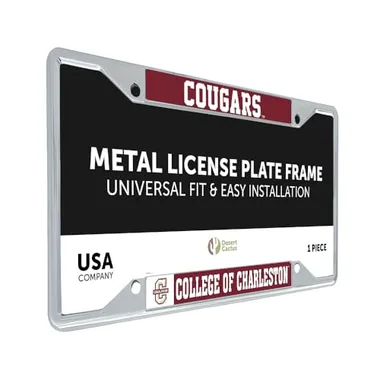
College of Charleston Cougars Number Plate Frame
6.25 in · Zinc alloy · $19.99
A keyring is the everyday object of the three, and it is the one to buy if you want the team to be part of an ordinary day rather than an occasion. It is also the cheapest way to test whether a supplier's colours are any good, because a bad colour match is glaringly obvious at two inches.
Greek life, which is its own world
Fraternity and sorority pieces deserve their own paragraph because the buying pattern is completely different. A chapter has a few hundred members, a set of letters, and often colours and a badge that are as specific and as protected as any university crest.
We make 404 pieces for Greek organisations, and every one of them goes through the same approval step as a university flag. The organisation holds the rights to its own letters and badges, and it approves the design chapter by chapter.
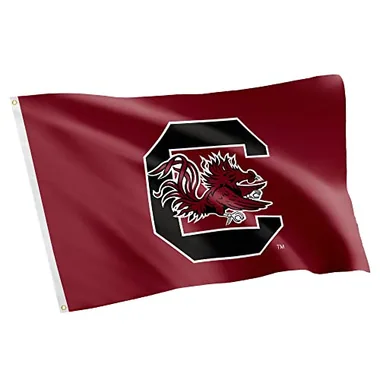
University of South Carolina USC Flag
3 x 5 ft · Polyester · $25.99
The practical consequence for a buyer is that the range for any single chapter is narrower than for a big university, and that the pieces are more likely to be jewellery, keyrings and letters than flags and plate frames. That reflects what chapters actually order.
Sources
- 16 CFR Part 1501 — Method for identifying toys and other articles intended for use by children under 3 years of age which present choking, aspiration, or ingestion hazardsU.S. Consumer Product Safety Commission, via the Electronic Code of Federal Regulations. Read 20 August 2026.