The car is the hardest place we sell into
A decal on a rear window lives a life nothing else in our range has to survive. It gets direct sun for hours, then a car wash at pressure, then a freeze, then road salt, then a heat cycle from the interior every time the car sits in a car park. Anything we print for a car has to be built for that or it will look shabby within a year.
We make 1,264 decals and stickers and 385 number plate frames. This guide is what we have learned about both, including the parts that are inconvenient for us to say.
What a cut vinyl decal actually is
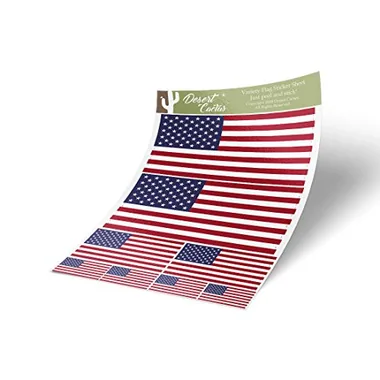
United States of America USA Stickers
4 in · Vinyl · $9.99

There are two completely different things sold under the word decal, and telling them apart matters. The first is a printed sticker: an image printed on a sheet of vinyl with a visible rectangular or shaped border. The second is cut vinyl: the shape is cut out of coloured vinyl and there is no background at all, so what sits on your glass is the logo and nothing else.
Cut vinyl looks better on a car and lasts longer, because there is less surface for an edge to lift from and no printed layer to fade off a backing. It is also less forgiving to apply, because there is nothing holding the pieces in position except transfer tape.

Ohio State Buckeyes Car Decal
Vinyl · $11.99
Both of ours are made with UV resistant ink and adhesive intended for outdoor use. Neither is designed to be moved once it is down. Vinyl adhesive builds strength over the first day or two, so the window to reposition is measured in seconds, not minutes.
| Kind | What you see | Best on | Watch out for |
|---|---|---|---|
| Cut vinyl | The shape only, no background | Glass, painted metal, laptops | One chance to place it |
| Printed sticker | Image with a visible border | Water bottles, notebooks, helmets | Edges lift first |
| Car magnet | Flexible sheet, no adhesive | Flat steel panels only | Not aluminium, not plastic |
Applying one so it stays on
Almost every failed decal failed at the cleaning step. Glass looks clean and is not: it carries a film of road grime and, on the inside, an oily haze from the interior plastics. Adhesive sticks to that film rather than to the glass, and when the film moves, the decal moves with it.
Clean with isopropyl alcohol rather than window cleaner. Household glass cleaners leave a residue by design, because the residue is what stops streaking. That residue is the enemy here. Wipe with alcohol, let it flash off completely, then do not touch the area with your fingers.
Temperature is the other half. Vinyl adhesive needs warmth to flow into the surface. Applying below about 50 degrees Fahrenheit gives a bond that looks fine and lifts in a month. If it is cold outside, bring the car somewhere warm, or wait.

Vegas Golden Knights Car Decal
Vinyl · $9.99
- Clean with alcohol, not window cleaner.Glass cleaner leaves an anti-streak residue, and adhesive bonds to the residue instead of the glass.
- Work above 50 degrees Fahrenheit.Cold adhesive never flows properly into the surface and the decal lifts within weeks.
- Squeegee from the centre out.A credit card wrapped in cloth works. Air pushed to the edge escapes. Air trapped in the middle does not.
- Leave the transfer tape for an hour.Pull it back on itself at a shallow angle, not straight up, or you will lift the vinyl with it.
- Do not wash the car for two days.The bond keeps building for about 48 hours. Pressure washing before then is how edges start lifting.
Taking one off without damaging anything

Caitlin Clark Indiana Fever Car Decal
Vinyl · $9.96
Removal is where the real damage happens, and it happens for one reason: people try it in winter. Cold vinyl is brittle. It tears into confetti, leaves the adhesive behind, and turns a five minute job into an hour of scraping.
Warm the decal first. A hair dryer at moderate heat for a minute is enough on glass. Then lift a corner with a fingernail or a plastic card and pull slowly, at a shallow angle, back across itself. The slower you pull, the more likely the adhesive comes with the vinyl instead of staying on the glass.
Whatever adhesive remains comes off with isopropyl alcohol or a dedicated adhesive remover. On glass you can also use a plastic razor. On paint, do not use any razor at all, and test any solvent on a hidden panel first.
Rear window heating elements, and the one real warning
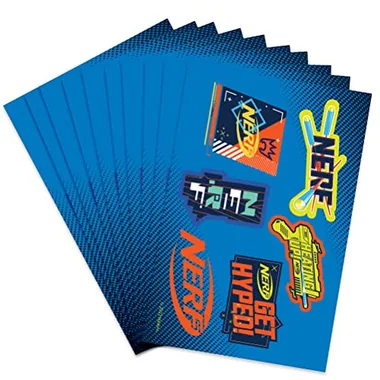
Nerf Car Decal
Vinyl · $14.99
Many cars have heating elements printed onto the inside of the rear window as fine horizontal lines, and some have a radio antenna printed there too. Those elements are fragile and they are on the inside.
If you apply a decal to the outside of a rear window, none of this matters. If you apply one to the inside, which people do for a cleaner look, you are working directly on top of them, and scraping or aggressive removal there can break a line and kill the demister across a whole strip of glass. Repair is possible with conductive paint but it is fiddly and visible.
Our advice is simple: put decals on the outside of a rear window, or on the inside of a side window where there are no elements.
Number plate frames, and what universal fit means
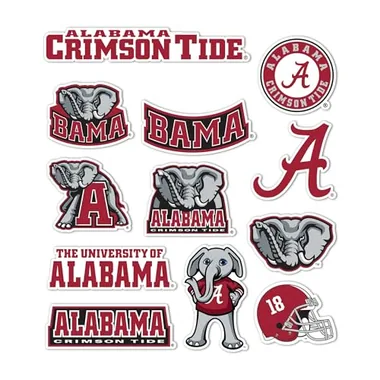
Alabama Crimson Tide Car Decal
Vinyl · $11.99
A number plate frame is a rectangle of metal or plastic that sits between your plate and the car, held on by the same screws. Ours are chrome finished or coloured metal, sized for a standard United States plate, and drilled to a pattern that matches the mounting holes used on almost every car sold in the country.
That is what universal fit means, and it is worth being precise about it, because the phrase gets used loosely. It means the frame matches the standard plate size and the standard hole spacing. It does not mean the frame fits every car ever built, and it does not mean the screws that came with your car are the right length once a frame is added.

Georgia Bulldogs Car Decal
Vinyl · $11.99
The screw question is the one that catches people. Adding a frame adds a few millimetres of thickness, and the original screws may no longer engage enough thread. Most frames ship with screws for exactly this reason. Use them.
| Claim | What it means | What it does not mean |
|---|---|---|
| Universal fit | Standard US plate size and hole spacing | That every vehicle mount is identical |
| Chrome finish | A bright plated surface over metal | Solid chrome, which nothing is |
| Two piece | Front and rear frames in the box | That your state requires two plates |
| Rust resistant | Plating and coating resist corrosion | That road salt never wins |
The legal bit, which varies by state
Number plate frames are regulated, and the regulation is a state matter rather than a federal one. The rules that exist almost always concern obscuring information: the plate number itself, the state name, the registration stickers, and any slogan the state has decided is part of the plate.
A frame that covers only the outer edge of the plate is fine everywhere we know of. A frame with a thick bottom bar that covers the state name is not fine in several states. We cannot give you your state's rule and we are not going to pretend otherwise, but the test is easy to apply yourself: fit the frame, stand behind the car, and check that every piece of printed information on the plate is still readable.
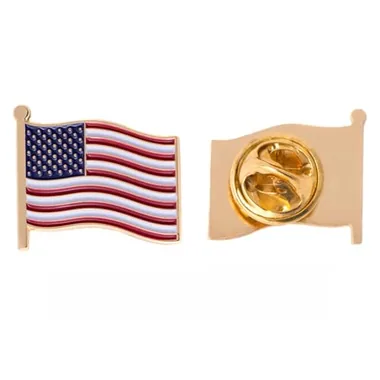
United States of America Lapel Pin
Enamel on metal · $5.90
The same applies to tinted or smoked plate covers, which are a different product from a frame and are prohibited far more widely. We do not make them.
Fade, and why the ink matters more than the design
Colour on a car takes the worst ultraviolet exposure of anything we sell. A decal on a south facing rear window in a hot state receives more direct sun in a year than a flag in a shaded garden receives in five.
We print with fade resistant inks for that reason, and the difference is most visible in the colours that fade first. Reds and yellows go before blues and greens, because the pigments that make them are less stable. A cheap red decal turns pink from the top down, and it does it in one summer.

University of Michigan Wolverines Flag
3 x 5 ft · Polyester · $24.75
There is no such thing as a decal that never fades. There are decals that take four or five years to look tired and decals that take one, and the whole difference is in ink and vinyl quality that you cannot see when you buy.
Sizing a decal to the glass it goes on
The most common regret with a car decal is not quality, it is scale. A logo that looks right on a screen at 200 pixels is being judged against nothing. On a rear window it is being judged against the window, the wiper, the third brake light and the badge on the boot lid, and a decal that fights any of those looks wrong however well it is made.
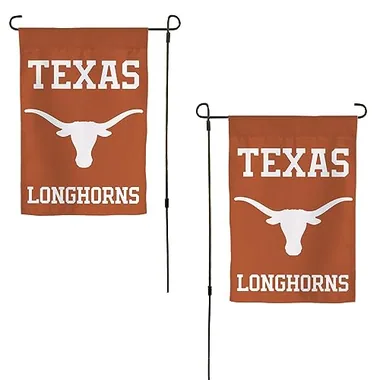
University of Texas Garden Flag
12 x 18 in · Polyester · $13.99
The rule we give people is to work from the smallest fixed feature nearby rather than from the glass as a whole. If there is a brake light in the middle of the window, a decal roughly the width of that light will sit comfortably. If there is a wiper, keep clear of its arc entirely, because a wiper crossing a decal will destroy the edge within a year regardless of how well it was applied.
Corner placement almost always beats centre placement on a rear window, for a reason that has nothing to do with taste: the centre of a rear window is where the demister lines are densest and where the view out of the mirror matters most.

Mexico Lapel Pin
Enamel on metal · $8.99
On side windows the constraint is different. Most side glass drops into the door, and a decal placed low enough to disappear into the door seal will be scraped every time the window opens.
| Surface | Sensible size | Place it | Avoid |
|---|---|---|---|
| Rear window | 4 to 6 in | Lower corner, driver side | The wiper arc, the demister centre |
| Side window | 3 to 4 in | Upper rear corner | Anything the seal will scrape |
| Painted panel | 4 to 6 in | Flat area, not a crease | Body lines and edges |
| Laptop lid | 3 to 4 in | Off centre, clear of hinges | Vents and the camera |
| Water bottle | 2 to 3 in | Flat face if there is one | Steep curves, dishwasher heat |
Car washes, wax and what actually strips a decal
A properly applied decal on clean glass survives an automatic car wash without complaint, and it will survive many of them. What kills decals in car washes is not the brushes, it is the edge. Any lifted corner gives the brush something to catch, and once a brush has caught a corner it will take the whole thing off in one pass.
So the maintenance is simply to look at the edges occasionally. If a corner is lifting, press it back down while the car is warm and it will usually re-bond. If it will not, that decal is finished and it is better to take it off deliberately than to let a car wash tear it in half.
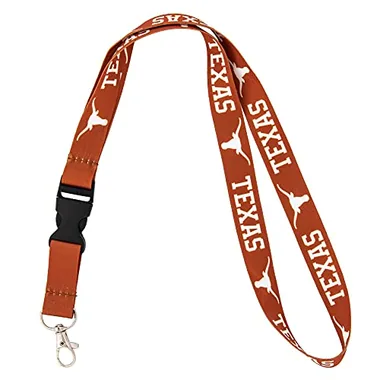
Texas Longhorns Lanyard
Polyester · $11.99
Pressure washers are more dangerous than brushes. A jet held close and square to a decal edge will get under it in seconds. Keep the lance at least a foot away and never aim directly at an edge.
Wax and polish are fine over a decal on paint, but avoid cutting compounds, which are abrasive by design and will dull the vinyl surface far faster than they will affect the paint around it.

University of Texas Austin Longhorns Flag
3 x 5 ft · Polyester · $24.75
- Check the edges monthly.A lifted corner is the only thing that turns a car wash into a decal removal service.
- Keep pressure washers a foot back.A close jet aimed at an edge lifts vinyl in seconds.
- Wax over it, do not cut over it.Polish is fine. Cutting compound is abrasive and dulls the vinyl.
- Re-press warm, not cold.A lifting corner will usually re-bond on a warm day and will not on a cold one.
Winter, salt and the screw you cannot remove
Number plate frames spend their lives at the lowest, dirtiest point on a car, taking every stone and every gallon of salt spray from the road. That is the environment they have to survive, and the part of them that fails is never the frame.
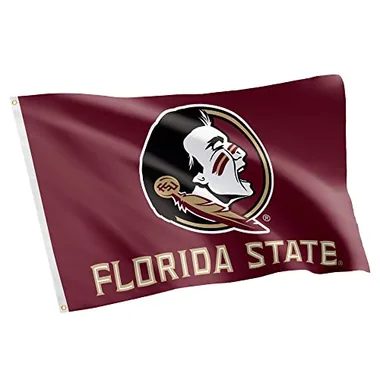
Florida State University FSU Flag
3 x 5 ft · Polyester · $24.75
It is the screws. Steel screws in a steel or aluminium plate mount, salted repeatedly, seize. Anyone who has tried to remove a plate after four winters has met a screw head that rounds off under the screwdriver rather than turning.
The fix is trivial and almost nobody does it. Put a smear of anti-seize compound or even ordinary grease on the screw threads when you fit the frame. It takes ten seconds and it means the screws come out again in five years.
The second winter habit is to take the frame off once a year, clean behind it, and put it back. Salt and grit collect between frame and plate, and the paint on a plate under a permanently fitted frame corrodes far faster than the exposed parts.
Everything else a decal goes on
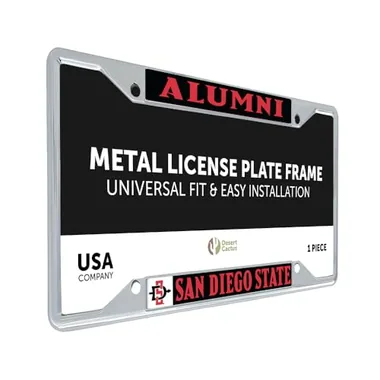
SDSU San Diego State Aztecs Number Plate Frame
6.25 in · Zinc alloy · $19.99
A large share of the decals we sell never touch a car. They go on laptop lids, water bottles, notebooks, tool boxes, helmets and dorm room mirrors, and each of those surfaces behaves differently enough to be worth a line.
Laptop lids are the easiest surface in the world for vinyl: flat, clean, room temperature, and never washed. A decal there will outlast the laptop. Keep it clear of vents and hinges.
Water bottles are the hardest. They are curved in two directions, they go through dishwashers, and dishwasher heat combined with detergent is exactly what breaks down adhesive. Hand wash anything with a decal on it, and expect a curved surface to lift at the edges eventually no matter what you do.
Boston Celtics C’s Keyring
PVC · $9.99
Helmets deserve a warning of their own. Some helmet manufacturers state that adhesives and solvents can affect the shell, and their guidance overrides ours. If your helmet came with a note about stickers, follow it.
Reflective, holographic and the finishes that cost more
Beyond plain coloured vinyl there are three finishes worth knowing about, because they are priced differently and they behave differently.
Reflective vinyl contains glass beads that throw headlight back at the driver behind you. It looks like ordinary white or grey vinyl by day and lights up at night. It is genuinely useful on a bicycle, a trailer or a dark coloured car, and it is the one specialist finish with a practical argument behind it.
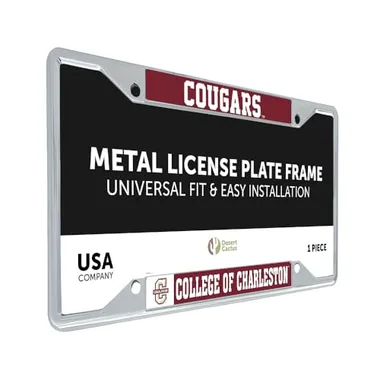
College of Charleston Cougars Number Plate Frame
6.25 in · Zinc alloy · $19.99
Holographic and chrome finishes are decorative. They look striking in a photograph and they scratch more easily than flat colour, because the effect lives in a thin surface layer. On a rear window that never gets touched they last well. On a laptop lid that goes in and out of a bag they do not.
Matte black is the finish people underestimate. It reads as subtle rather than loud, it hides dust, and on a dark car it looks like it was applied at the factory. If you want your team on the car without announcing it to the whole car park, that is the one to ask for.
Magnets, which are a different animal

University of South Carolina USC Flag
3 x 5 ft · Polyester · $25.99
A car magnet is not a decal. It has no adhesive, it sits on the panel by magnetic attraction, and it comes off in seconds. That makes it the right answer for a leased car, a work vehicle, or anybody who wants their team on the car during the season and off it afterwards.
It also brings two problems nobody mentions. Aluminium and plastic panels are not magnetic, and a surprising number of modern bonnets, boot lids and wings are one or the other. Check with a fridge magnet before you buy.

Virginia Tech Flag
3 x 5 ft · Polyester · $25.99
The second problem is dirt. Grit gets between magnet and paint and grinds a dull patch as the car moves. Take the magnet off once a week, clean both the panel and the back of the magnet, and put it back. Magnets left on for a whole season leave a visible outline, and on older paint that outline does not polish out.