
A flag is not a poster
The first flag most people buy outdoors is also the first one they are disappointed by, and the reason is almost never the flag. It is the spot. A flag mounted on the corner of a house where two walls funnel the wind will be frayed in a season. The same flag on a pole in an open garden will still look right two years later. Nothing about the fabric changed. The air did.
We make our full size flags to 3 by 5 feet, printed on 150D polyester, with a reinforced canvas header and two metal grommets on the pole edge and four rows of stitching at the free edge. Every one of those choices is a response to a specific way flags die, and it is worth knowing which is which before you decide where to hang one.

University of Michigan Wolverines Flag
3 x 5 ft · Polyester · $24.75

This guide covers the pole, the wind, the weather, the law where there is law, and the maintenance that doubles the life of the thing. It is longer than a product page because the honest answer is longer than a product page.
What the parts are for
Start at the pole edge. That edge carries the entire weight of the flag plus everything the wind adds to it, and it is attached to a metal pole by two small holes. If the fabric there is the same weight as the rest of the flag, the holes tear out. So the pole edge is not flag fabric at all: it is a band of heavy canvas sewn on, with brass grommets set through it. When people say a flag has a header, that is what they mean.
University of Texas Austin Longhorns Flag
3 x 5 ft · Polyester · $24.75
Now the free edge, which flag people call the fly end. In any wind above a whisper, the fly end is snapping back and forth many times a second. That motion works threads loose at the very tip, and once the first thread goes the fabric unzips along the weave. Four rows of stitching there is not decoration, it is four separate chances to stop the unzipping.
The middle of the flag does almost nothing. It takes sunlight, and that is a slower problem. Polyester with decent ink holds its colour through a summer without much complaint, and the flag is usually physically worn out before it is visibly faded.
| Part | What it does | How it fails | What we do about it |
|---|---|---|---|
| Fly end | The free edge, furthest from the pole | Frays, then unzips along the weave | Four rows of stitching |
| Header | The pole edge that carries the load | Grommets tear out of the fabric | Reinforced canvas band |
| Grommets | Two metal eyelets for clips or ties | Pull out, or corrode and stain | Metal, set through canvas |
| Field | The printed body of the flag | Fades in strong sun over seasons | 150D polyester, pigment inks |
Wind, in numbers rather than adjectives
Wind speed is the single best predictor of how long your flag lasts, and most people have no idea what speed they are looking at. The National Weather Service publishes a scale that matches wind speed to things you can see, and it mentions flags by name.
Leaves and small twigs in constant motion. Wind blows up dry leaves from the ground. Flags are extended out.Beaufort Wind Scale, National Weather Service, Portland Oregon forecast office. Read 20 August 2026.
That is 8 to 12 miles per hour. It is a pleasant day. It is also the condition your flag spends most of its working life in, and it is what the stitching is designed around. Below it, at 1 to 3 miles per hour, the scale describes something different again.
Direction of wind shown by smoke drift, not by wind vanes. Little if any movement with flags. Wind barely moves tree leaves.Beaufort Wind Scale, National Weather Service, Portland Oregon forecast office. Read 20 August 2026.
A flag that hangs is a flag that is not wearing out. This is why a sheltered courtyard is kinder to a flag than an open lawn, and why the same flag lasts wildly different lengths of time at two houses on the same street.
The number that should worry you is 32 to 38 miles per hour, which the scale calls a gale and describes as twigs breaking off trees. A few hours in that will do more damage than a month of gentle breeze. If you are the kind of person who wants a flag to last, the single highest value habit is bringing it in when a storm is forecast.
| Speed | Name | What you can see | Effect on a flag |
|---|---|---|---|
| 1 to 3 mph | Light air | Little if any movement with flags | None worth counting |
| 4 to 7 mph | Light breeze | Wind felt on face, leaves rustle | Gentle movement, negligible wear |
| 8 to 12 mph | Gentle breeze | Flags are extended out | The normal working load |
| 19 to 24 mph | Fresh breeze | Small trees in leaf begin to sway | Real wear at the fly end |
| 32 to 38 mph | Gale | Twigs break off trees | Bring it in |
The pole, and why ours is not included
We do not ship a pole with a flag, and that is a choice, not a saving. Poles are the most personal part of this purchase. Somebody mounting a flag on a house wall needs a 5 or 6 foot angled pole in a bracket. Somebody with a lawn wants a 15 to 20 foot ground pole set in concrete. Somebody in an apartment wants a 4 foot pole in a window clamp. A flag that arrives with the wrong pole is worse than a flag with no pole.
Florida State University FSU Flag
3 x 5 ft · Polyester · $24.75
What matters is the relationship between the two. A 3 by 5 foot flag wants roughly a 15 to 20 foot pole on the ground, or a 5 to 6 foot angled pole on a wall. Hang a 3 by 5 on a pole that is too short and it will touch the ground, which the flag code has views about when a national flag is involved, and which will destroy the fly end within weeks regardless.
| Flag size | Ground pole | Wall mounted pole | Typical use |
|---|---|---|---|
| 3 x 5 ft | 15 to 20 ft | 5 to 6 ft angled | House front, garden, dorm wall inside |
| 12 x 18 in garden | Garden stake, about 40 in | Not usual | Lawn, border, front path |
| About 28 x 40 in house | Not usual | Bracket arm, about 40 in | Porch post, wall beside a door |
When a national flag joins the pole
This is where the guide stops being advice and starts being law, or at least published federal custom. If you fly a team flag on its own, none of this applies. The moment a flag of the United States is on the same halyard or an adjacent staff, there is a code, and it is short and specific.
When flags of States, cities, or localities, or pennants of societies are flown on the same halyard with the flag of the United States, the latter should always be at the peak. When the flags are flown from adjacent staffs, the flag of the United States should be hoisted first and lowered last. No such flag or pennant may be placed above the flag of the United States or to the United States flag’s right.4 U.S. Code § 7 — Position and manner of display, Legal Information Institute, Cornell Law School. Read 20 August 2026.
Read that carefully, because it contains three separate rules. The national flag goes at the peak when flags share a halyard. It is raised first and lowered last when flags are on separate poles. And no other flag may sit above it or to its right, which from the flag's own point of view means the viewer's left.
The same section covers what to do when flags of two countries are involved, which comes up more often than you would think for anyone flying a national side alongside the stars and stripes.
When flags of two or more nations are displayed, they are to be flown from separate staffs of the same height. The flags should be of approximately equal size.4 U.S. Code § 7 — Position and manner of display, Legal Information Institute, Cornell Law School. Read 20 August 2026.
Separate staffs, same height, roughly equal size. That is the whole rule, and it rules out the common arrangement of a small national flag under a large team flag on one rope.
Night, weather and the two questions we get most
Two questions arrive constantly. Can I leave it up at night, and should I take it down in the rain. Both are answered directly in the code, and both answers are more relaxed than people expect.
It is the universal custom to display the flag only from sunrise to sunset on buildings and on stationary flagstaffs in the open. However, when a patriotic effect is desired, the flag may be displayed 24 hours a day if properly illuminated during the hours of darkness.4 U.S. Code § 6 — Time and occasions for display, Legal Information Institute, Cornell Law School. Read 20 August 2026.
So a lit flag can stay up around the clock. An unlit one is customarily brought down at sunset. Note that this is the rule for the national flag: a team flag has no such custom attached to it, and nobody will object to a university crest flying in the dark.
Weather is the other one, and here the code is blunt.
The flag should not be displayed on days when the weather is inclement, except when an all weather flag is displayed.4 U.S. Code § 6 — Time and occasions for display, Legal Information Institute, Cornell Law School. Read 20 August 2026.
An all weather flag in this context means one made from a synthetic that does not rot when wet, which polyester is. So the letter of the rule permits it. Our own advice is different and simpler: rain will not hurt the flag, wind will, and storms bring both. Take it down for the storm and you have taken it down for the rain anyway.
Washing, mending and getting a second season
Most flags that get thrown away are dirty rather than finished. Road film, pollen and dust flatten the colour until a flag looks tired, and a wash brings back a startling amount of it. Cold water, mild detergent, no bleach, air dry. Do not put a flag in a tumble dryer, because heat is what sets the creases you will never get out.
University of South Carolina USC Flag
3 x 5 ft · Polyester · $25.99
The second repair is more useful still. When the fly end frays, cut it. Take a straight edge, trim the damaged tip square, fold a narrow hem and sew it. You lose an inch or two of flag and gain a season of life, and at 3 by 5 feet nobody will ever notice the difference.
Grommets are the third thing and the one people forget. If a grommet starts to pull, stop flying the flag until it is fixed, because a flag hanging by one grommet twists and destroys itself within days.
Virginia Tech Flag
3 x 5 ft · Polyester · $25.99
- Wash cold, air dry.Mild detergent, no bleach, no tumble dryer. Heat sets creases permanently.
- Trim and hem the fly end.A square cut and a narrow hem buys another season for the price of ten minutes.
- Watch the grommets.One failing grommet lets the flag twist, and a twisting flag tears itself apart quickly.
- Bring it in for storms.The single highest value habit. A gale does more damage in an afternoon than a month of ordinary weather.
- Rotate two flags.If you fly year round, two flags alternating last more than twice as long as one flown continuously.
Indoors, which is where most of them end up
A large proportion of the 3 by 5 foot flags we make never see weather at all. They go on walls, in dorm rooms, over beds, behind bars and across ceilings, and for that job a full size flag is the cheapest large piece of wall covering available anywhere.

University of Tennessee UT Flag
3 x 5 ft · Polyester · $25.99
Indoors, none of the durability discussion matters. What matters is how you hang it, and the answer is almost always tacks or small clips through the grommets plus two more along the top edge to stop the middle sagging. Do not stretch it tight. A flag hung with a little slack reads as a flag. A flag stretched drum tight reads as a bedsheet.
The one rule worth knowing indoors involves a window, and it is again about national flags rather than team ones.
When the flag of the United States is displayed from a staff projecting horizontally or at an angle from the window sill, balcony, or front of a building, the union of the flag should be placed at the peak of the staff unless the flag is at half-staff.4 U.S. Code § 7 — Position and manner of display, Legal Information Institute, Cornell Law School. Read 20 August 2026.
Garden flags, the format that quietly wins
If you asked us which piece in the range gives the most satisfaction per dollar, the answer is not the one people expect. It is the 12 by 18 inch garden flag. We make 167 of them, and the customers who buy one very rarely come back unhappy.
The reason is physics rather than quality. A garden flag sits two or three feet off the ground on a stake, usually in a border, usually with a hedge or a wall or a car on at least one side. All of those break the wind before it reaches the flag. On top of that, a small flag gives the wind far less leverage: the force on a flag rises with its area, and a garden flag has about a tenth the area of a full size one.

University of Texas Austin Longhorns Flag
3 x 5 ft · Polyester · $24.75
The result is a flag that flies for years in a spot where a 3 by 5 would be in ribbons by March. It is also the format that works in a rented house, because a stake pushes into soil and leaves no hole in anything you will be asked about later.
The one thing to get right is the stake. Garden stakes come in a standard shape with a horizontal arm and two hooks, and the flag sleeve slides down over the arm. Cheap stakes bend where the arm meets the upright, and a bent stake lets the flag wrap itself round the pole every time the wind swings. Buy a heavier one than you think you need.
Choosing the spot, walked through properly
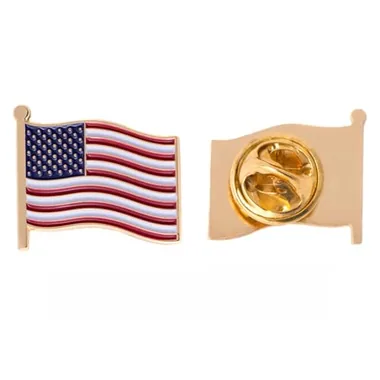
United States of America Lapel Pin
Enamel on metal · $5.90
Most people choose a flag position by looking at the house and deciding what looks good. That is the right instinct and the wrong first question. Start with where the wind comes from, because that decides whether you are choosing a display or a consumable.
Stand outside on an ordinary breezy day and watch. Wind that has come across open ground arrives smooth and steady, and a flag in it flies flat and wears slowly. Wind that has come round a corner, over a roofline or between two buildings arrives turbulent, and a flag in turbulence does not fly. It snaps, and snapping is what destroys the fly end.
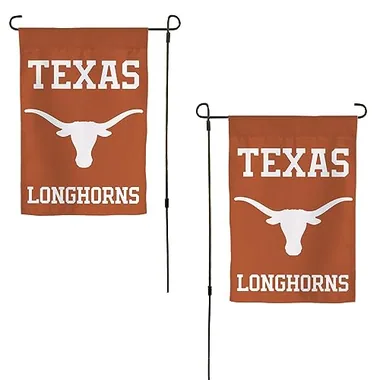
University of Texas Garden Flag
12 x 18 in · Polyester · $13.99
The worst position in an average garden is a wall mounted pole on the corner of a house, which is also the most popular one. Two wall faces meet there and the air tumbles. The best is an open pole set back from the building far enough that the house is not funnelling anything at it.
If the good position is not available, and often it is not, the fix is a smaller flag. A garden flag in a turbulent corner will outlive a full size flag in the same corner by years.
| Position | Air behaves | Life expectancy | Better option |
|---|---|---|---|
| Open pole, set back | Smooth, steady | Longest | Full size flag is fine |
| Porch bracket, sheltered | Broken by the building | Long | House flag |
| Garden stake in a border | Broken by planting | Long | Garden flag |
| Wall mount on a flat face | Some turbulence | Medium | Full size, expect a season or two |
| Wall mount on a corner | Tumbling, turbulent | Shortest | Go smaller, or move it |
Two flags, and the rotation that pays for itself
Anybody who flies a flag year round should own two of them and swap them every few weeks. This is the least intuitive advice in this guide and the one that makes the biggest difference, so it is worth explaining why it works.
Flag fabric fails by fatigue rather than by wear. The threads at the fly end are being bent back and forth, and like any material bent repeatedly they lose strength with the number of cycles rather than with elapsed time. Resting a flag does not repair it, but taking one down and putting another up halves the cycles each one sees in a year.
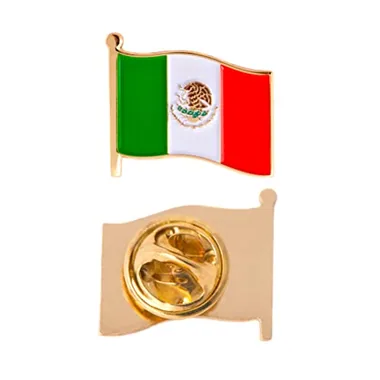
Mexico Lapel Pin
Enamel on metal · $8.99
The second reason is more mundane. Two flags means you always have a clean one, so the dirty one gets washed instead of getting flown until it looks bad enough to throw away. Most flags reach the bin looking far worse than they are.
At the prices in this category the arithmetic is easy. Two flags rotated do not last twice as long. They last considerably more than twice as long, because neither one is ever the exhausted one still up in a gale in February.
Questions we cannot answer honestly
There are three questions we get regularly where the truthful answer is that we do not know, and it seems better to say so than to invent something confident.
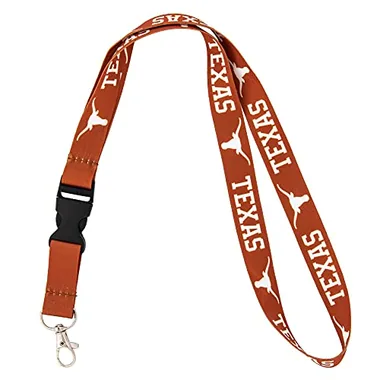
Texas Longhorns Lanyard
Polyester · $11.99
How many months will my flag last is the first. It depends on the position, the local wind, the sun, whether you bring it in, and whether you wash it, and those factors vary more between two houses than between two flags. Anybody quoting you a figure without asking where you live is guessing.
Whether it is waterproof is the second. Polyester does not absorb much water and does not rot, so rain does it no harm. That is not the same as waterproof, which means something specific about resisting water passing through, and it is not a claim that means anything about a flag.
Whether the colours will match another supplier's version of the same team is the third. Ours match the specification the institution approved. If another vendor's differ, one of the two did not go through approval, and we cannot tell you which from here.
What to buy for what
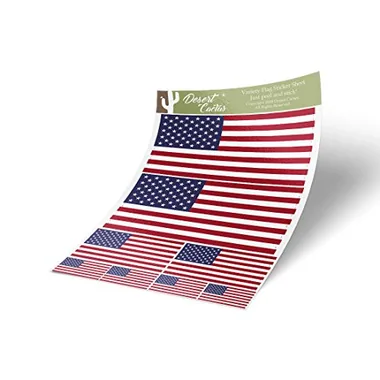
United States of America USA Stickers
4 in · Vinyl · $9.99
A short summary, because the whole guide comes down to matching format to place. Full size flags for poles and walls. Garden flags for lawns and borders, where the wind is broken by everything around them and a small flag survives happily. House flags for brackets on porches, where they are protected by the building itself.
If you are furnishing a room rather than a garden, buy the 3 by 5. If you are marking a front path, buy the garden flag and the stake to go with it. If you want the thing that lasts longest for the least attention, buy the garden flag: low to the ground, sheltered by the house and the hedge, and small enough that the wind never gets real leverage on it.
Sources
- Beaufort Wind ScaleNational Weather Service, Portland Oregon forecast office. Read 20 August 2026.
- 4 U.S. Code § 7 — Position and manner of displayLegal Information Institute, Cornell Law School. Read 20 August 2026.
- 4 U.S. Code § 6 — Time and occasions for displayLegal Information Institute, Cornell Law School. Read 20 August 2026.